


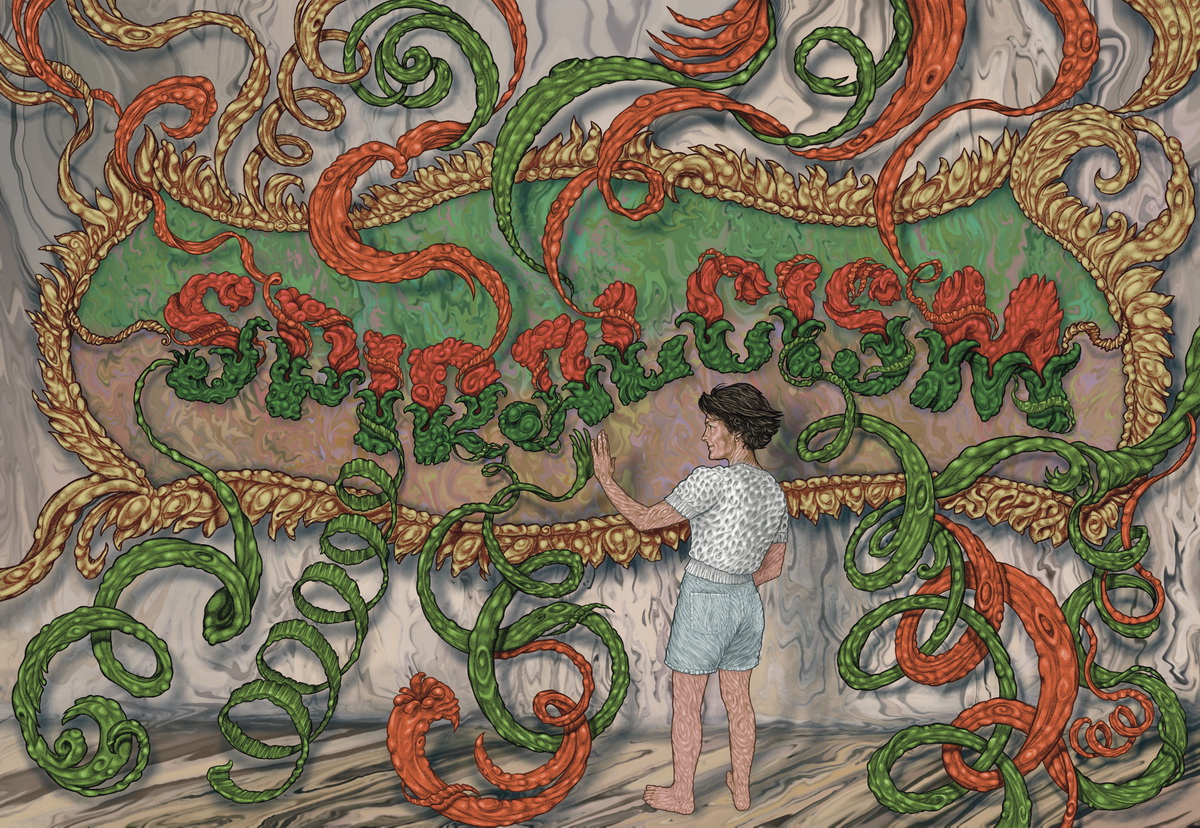
MANIFESTO OF THE ARTISTIC MOVEMENT
Author: Serj SHATSKOV
Spiralcism is a new artistic movement in which familiar forms lose their rigid boundaries, submitting to the laws of total dynamics.
The main visual marker and distinctive signature of the style is the presence of spiral vortices permeating the pictorial space. Lines twist into whirlwinds and dynamic loops, drawing silhouettes, objects, and meanings into their movement. It is from this overarching concept of perpetual motion that the movement takes its logical and intuitively understandable name — SPIRALCISM.
When viewers encounter paintings in this style for the first time, they instinctively search for familiar reference points and something to hold on to: Salvador Dalí, Hieronymus Bosch, classical Surrealism, Expressionism, Pop Surrealism, or Lowbrow Art. But it is none of these. This is another time. Another form. Another reality.
Spiralcism seeks not only to show the viewer a transformed world, but also to draw them into the transformation itself. The boundary between observer and image becomes fluid: the viewer is still trying to examine and rationally explain what they see, while the space of the painting has already begun to affect their perception. The viewer searches for a point of stability — only to discover that the very ground beneath them is also in motion.
Today, Spiralcism exists in intricate graphic works and large-scale oil paintings, where the familiar world is turned inside out and transported into another dimension of perception.
Artist’s Statement
“Spiralcism demonstrates that art does not tolerate stereotypes. Any familiar form can be turned inside out and transformed into a flow in which no two elements are alike. I want the viewer to search for hidden codes encrypted within the paintings, to lose their familiar sense of stability, and at some point discover that they have already entered a space where reality itself twists into a spiral.”
DEFINING FEATURES OF THE STYLE
The Vortex Principle: constant movement, fluidity, and the twisting of forms as the foundation of composition.
Uniqueness of the Element: deliberate avoidance of repetition, symmetry, and ready-made visual patterns.
Fractal Illusion: familiar images unravel, fragment, and mutate, creating new volumes.
Visual Paradoxes: deliberate ambiguity of the narrative, playing with hidden meanings and metaphors.
Graphic Refinement: jewel-like precision of line as one of the characteristic features of the style at its current stage of development.
Viewer Involvement: the space of the artwork breaks down the distance between image and observer, transforming the viewer from an outside witness into a participant in the visual movement.
THEMES AND IMAGERY
Transformation and the Inner Vortex: representations of the metamorphoses of human consciousness and spirit.
Existential Motifs: isolation, loneliness, and the search for oneself amid the chaos of a changing world.
Reimagining the Ordinary: deconstruction of familiar symbols and signs.
The Individual Facing a Changing Reality: an attempt to preserve one’s own point of stability within a space where stability itself proves to be an illusion.
Paintings in the style of Spiralcism do not merely depict — they pulsate and move. They have no static beginning or end. The viewer’s gaze endlessly follows a line that will never become straight.